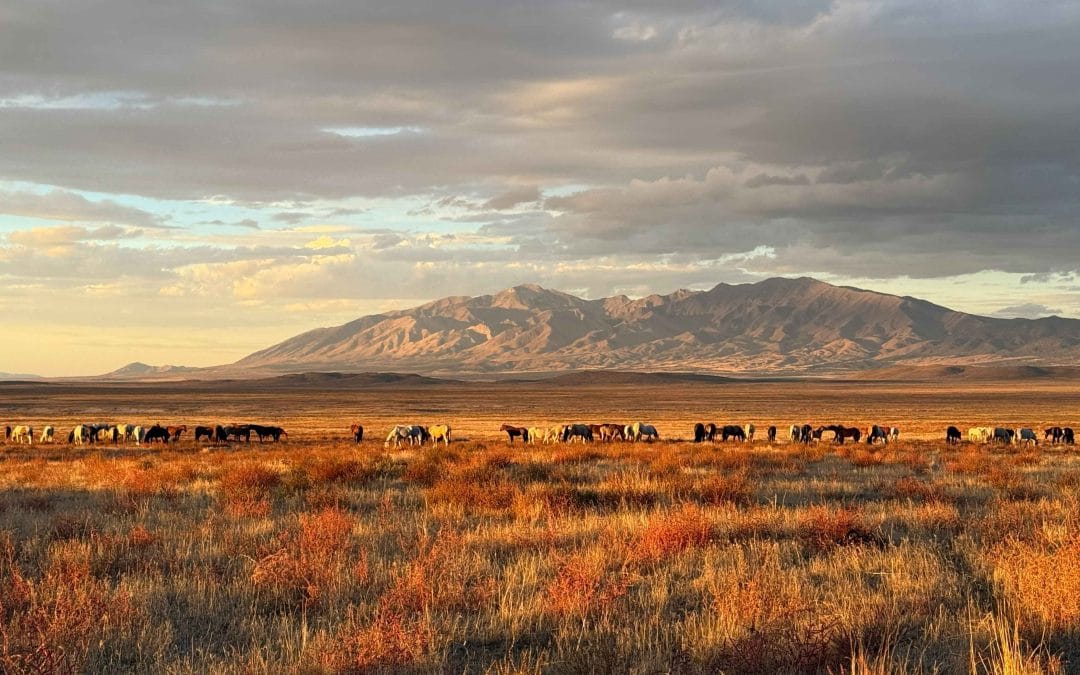
For years, wild horses in the United States have been removed through helicopter roundups. And when we discuss these operations, the debate usually centers on a few key questions:
Are roundups necessary?
Are they conducted humanely?
What happens to the captured horses?
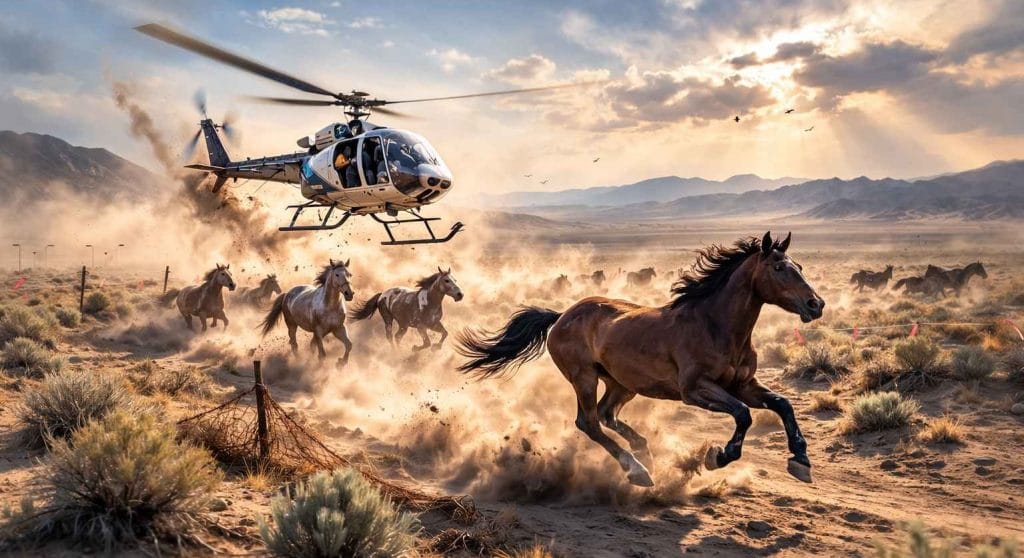
And these are extremely important questions to discuss. Some argue roundups are unavoidable – that horses are guided rather than chased, that the stress is brief, comparable to what wild horses experience fleeing predators in nature.
But what we actually see tells a different story. Horses chased to exhaustion. Foals struggling to keep up. Animals injured or dying during or shortly after capture.
The stress is very visible to those who are willing to look closely. The deaths are also very real. The footage of these roundups is hard to witness.
And yet, there’s something else we do not talk about as often. Something that doesn’t end when the helicopters leave, the traps close, and the trucks drive away.
What happens to the horses who remain.
Not those in holding facilities – we’ve seen those images.
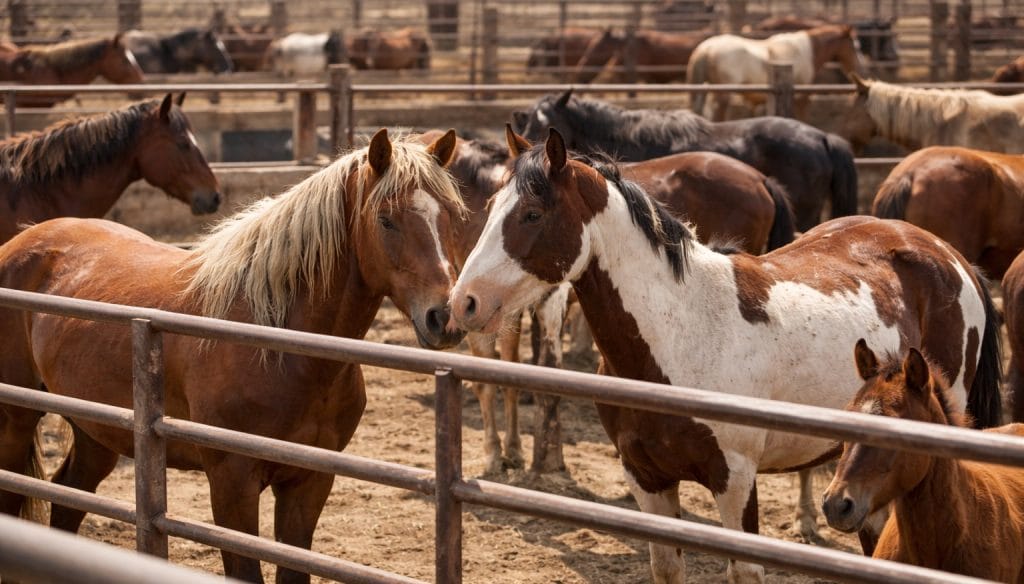
I’m talking about the ones considered “lucky.” The ones released back onto the range. The ones who escaped the chase. For them, everything is fine then, right?
No. It’s not.
Because there’s something often overlooked: the long-term social damage for those remaining on the range after a roundup.
When bands are torn apart, unrest continues for months, sometimes years. Horses struggle to rebuild what was destroyed. Stallions who lost their bands fight over remaining mares – conflicts that would be far less likely under stable conditions. Young horses grow up without stable protection, in a world that no longer feels safe. Families that functioned for years are separated forever. Horses grieve their loss.
So, even for the so-called lucky ones, the roundup isn’t brief stress.
It’s the beginning of ongoing social unrest and uncertainty.
So let’s talk about it.
Part 1: Social Structure and Long-Term Damage
Wild horses do not live in random collections of animals that can be taken apart and reassembled without consequence. They live in stable family bands that often remain intact for many years.
Wild Horses Do Not Live in Loose Groups
A band is not just “one stallion and some mares.”
It is a social system with roles, relationships, history, and learned coordination.
Stallions know their mares.
Mares know each other.
Young horses grow up inside a specific social environment, with familiar adults, predictable boundaries, and protection.
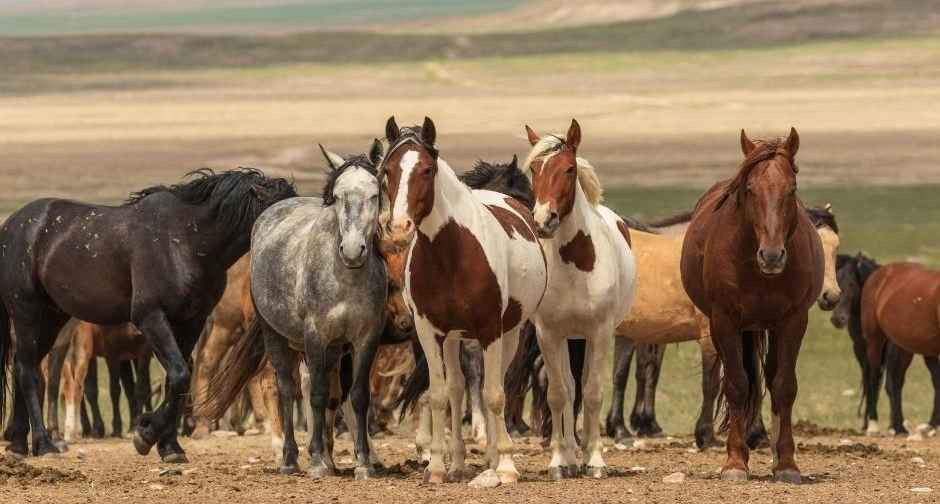
And no band lives alone. Every band is part of a larger social landscape – a herd association: these are several herds who live in the same area, drink from the same water sources, travel on the same trails, and most of them see each other daily.
These herd associations offer three major advantages: The first, and most important one is safety. More eyes mean better detection of threats. Second, social benefits. Stallions, mares, and young horses all recognize familiar neighbors. And third, ecological reasons. They share the same landscape, routes, and water sources. And many associations stay stable over generations.
Roundups Dismantle Families by Design
When these roundups take place the people who organize them do not selectively remove individual horses in a way that respects family structure. Roundups are built around efficiency, numbers, and logistics.
Bands are broken apart.
Mares are separated from stallions and from mares they are closely bonded to.
Young horses are split from their parents and familiar adults.
Lieutenants are removed or left behind without context.
When some of these horses are later released, those decisions are not based on social relationships or family structure. From the horses’ perspective, the result is effectively random.
This Is Not Comparable to Predation
One of the most common arguments used to downplay roundup stress is the comparison to predators.
“Wild horses face stress from predators too.”
“This is similar to a chase in nature.”
Biologically, this comparison does not hold.
Predation is local, brief, and selective.
It affects one individual or a small number of animals.
Once the event is over, the social structure of the band remains intact.
Roundups are the opposite.
They affect entire populations at once.
They remove large numbers of horses simultaneously.
And they permanently alter the social fabric of the herds that remain.
The stress does not end. It shifts from acute to ongoing.
The Real Cost Appears After Release
After a roundup, horses who were released (the ‘lucky ones’) are forced into a situation that almost never occurs naturally: mass social reorganization.
Multiple stallions suddenly compete for mares, who never belonged to them.
Bands who may remain partially intact collide without established boundaries.
Roles are unclear.
Previous alliances no longer apply.
This leads to months, sometimes years, of elevated conflict.
Increased fighting.
Constant movement.
Repeated band changes.
Ongoing tension rather than short, resolved encounters.
This is long-term stress, not acute stress.
Sunstar’s Story: What the Roundup Disrupted
In 2021, a helicopter roundup took place in the area where Sunstar and his band lived. Like many others, his herd was gathered and removed during the operation.
Before that roundup, Sunstar was an established herd stallion with a large, stable band. He was experienced, attentive, and predictable in his decisions. His lieutenant, Gabriel, supported him closely. Together, they kept their family safe in a way that had worked for years.
Then the roundup happened.
Sunstar and his entire band were captured. And then when some horses were later released back onto the range, Sunstar was among them. Gabriel was released as well. But Sunstar’s mares were not.
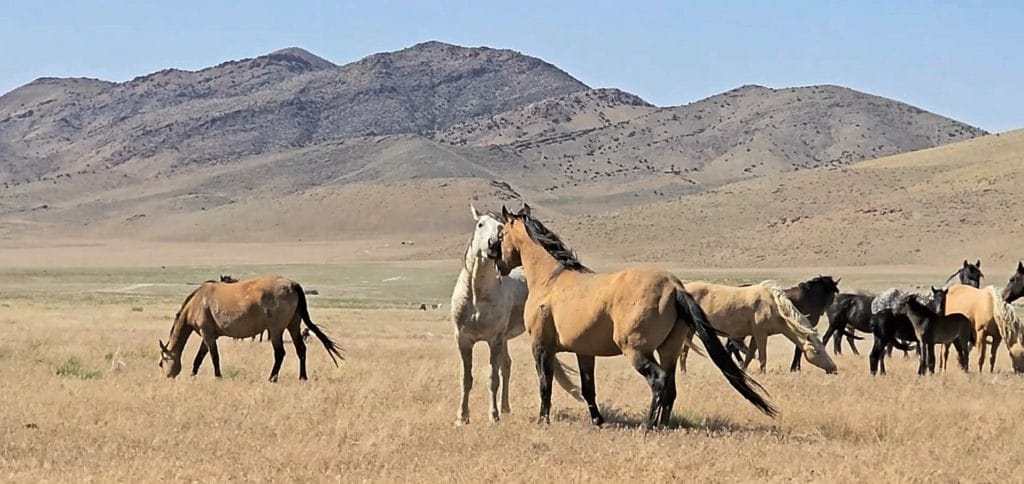
What remained from this band was an experienced herd stallion and his lieutenant, returning to the range without the family they had been responsible for a long time.
At that point, the damage was already done.
Now, a stallion without a band does not simply retire. He looks for a place to belong and a role to take on. So Sunstar joined the band of another stallion, Orion, initially as his lieutenant.
What followed was not a clean transition. It was a long period of instability.
Sunstar, Orion, and later Gabriel, who also joined this band, were all caught in a situation that had never been necessary. Sunstar had the experience and qualities of a band stallion, but no family of his own. Orion had mares but now shared his band with a highly competent rival. Gabriel, who had worked together with Sunstar as his lieutenant for years, was suddenly without a clear role.
This led to repeated tension and ongoing conflict. Not constant violent fights, but regular challenges, shifting alliances, and months of unrest. And the stress did not affect only the stallions. It affected the mares as well, who were repeatedly caught in changing dynamics.
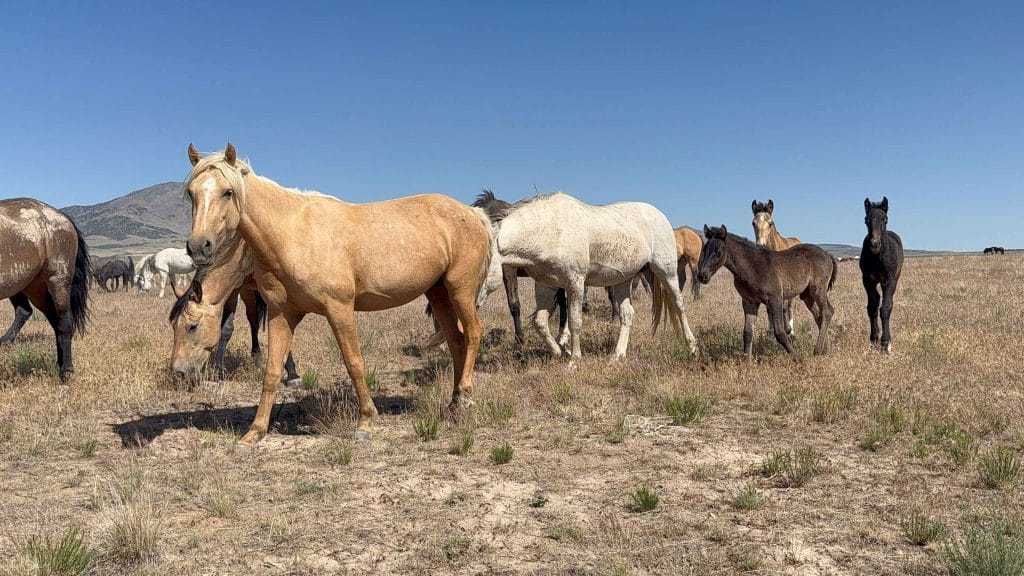
Only after almost two years did the situation slowly settle again. Sunstar eventually became the band stallion, with Gabriel again at his side. Orion remained as well, so the band now includes three adult stallions. Over time, a new family formed and stability returned.
But the important point is this:
none of this long-term stress was inevitable.
If even part of Sunstar’s original band had been left with him, especially some of his mares, there would have been no reason for this extended period of conflict. No need for years of instability. No need for multiple horses to constantly renegotiate their place.
This is what social disruption looks like after a roundup.
Not in minutes or days, but over years.
Foals and Young Horses Pay a Special Price
Young horses are especially affected by this kind of disruption.
They lose consistent protection.
They grow up in unstable social environments.
They are exposed to higher levels of conflict during critical developmental phases.
And this can shape their future behavior, stress tolerance, and social competence. Prolonged social instability can maintain elevated stress hormone levels. In many social mammals, chronic stress during development is known to affect behavior, learning, and long-term regulation.
None of these effects show up in roundup statistics. But they shape the population for years.
Which raises an obvious question.
If the long-term social damage is this severe, is there another way to manage wild horses?
Part 2: Biologically Informed Alternatives
If the long-term social damage is this severe, is there another way to manage wild horses?
There is.
Not a perfect way. Not an effortless way. But there are management models that work with the biology and social structure of wild horses instead of dismantling it.
And some of them are already working.
1) Birth Control Instead of Mass Removals
The most effective long-term alternative to roundups is fertility control. Not as a one-time intervention, but as a consistent management strategy.
Immunocontraception has been used in wild horse populations for decades. The most widely known method is PZP, which temporarily suppresses fertility for one to two years. When applied correctly, mares remain with their families, continue normal social behavior, and age naturally within their bands. Population growth slows gradually, without breaking social bonds.
Newer formulations such as PZP-22 were developed to extend duration and reduce the need for frequent boosters, though results in the field have been mixed. Another option, GonaCon-Equine, can suppress fertility for three to five years or longer, particularly with re-immunization — though it requires careful monitoring and follow-up.
One thing worth noting: in mares treated intensively over many years, PZP can in some cases lead to permanent infertility. Depending on management goals, this may or may not be desirable – but it is a factor that informed programs account for.
What these approaches share is simple:
They prevent future births without dismantling existing families.
Fertility control does not remove horses from the landscape. It reduces growth pressure while preserving social stability.
Does it actually work?
Yes – when implemented consistently and at sufficient coverage.
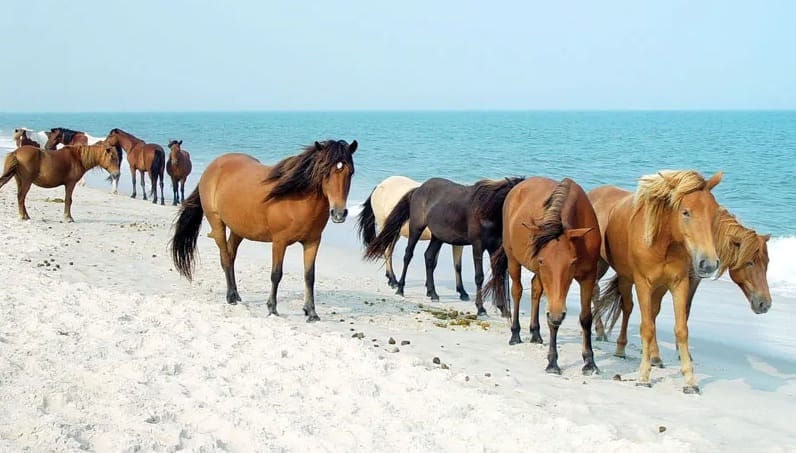
On Assateague Island, a long-running PZP program has managed the wild horse population for over 30 years without helicopter roundups. The herd remains stable, and family structures are preserved.
On the Virginia Range in Nevada, one of the largest fertility control programs in the world operates across roughly 300,000 acres and manages thousands of horses. Since 2019, the population has approached zero net growth through intensive, coordinated PZP application.
These programs show something important:
Roundups are not the only way to control population growth.
But fertility control requires something critical:
Monitoring.
Fertility Control Only Works With Good Monitoring
Contraception is not a magic button. It requires:
- reliable identification of individual mares
- the ability to relocate treated animals for boosters
- long-term tracking of band composition
Without monitoring, fertility control becomes guesswork.
With monitoring, it becomes precise.
And this is where technology is changing what is possible.
Birth Control Combined With AI and Modern Monitoring
In practical terms, this increasingly means camera traps placed at locations horses return to regularly – like water sources or established trails. Horses visit these places predictably, which makes them ideal for building up a consistent photographic record with minimal disturbance.
These cameras accumulate images of known individuals over time. AI then processes them, identifying specific animals by coat patterns, markings, or facial features. What once required days of manual photo comparison can now be done in hours.
The result is an evolving database of who is present, who belongs to which band, and which mares have already been treated.
Drones are also used in wildlife research to assist with aerial surveys and population counts. When applied carefully and at appropriate altitude, they can support large-scale monitoring. In some experimental settings, drones combined with AI-based identification are being explored for targeted contraceptive delivery – though this remains emerging technology rather than widespread practice.
The point is not that technology replaces observation.
The point is that it supports it.
2) Selective Removals Based on Social Structure
Even with fertility control, some removals may still be necessary. The real question is not whether horses are removed, but how and which ones.
Mass removals tear families apart.
Selective removals do not have to.
A socially informed approach starts with long-term observation. Bands are monitored over time. Relationships are understood. Roles within each family are identified. Only then does gathering take place.
Instead of helicopters and panic, calm ground-based gathering can be used. Horses are guided into enclosures in a controlled setting, without large crowds, without aerial pressure, and handled by experienced professionals.
This approach does not claim to be stress-free. Any capture is an intervention.
But it avoids mass separation and allows decisions to be made with social structure in mind.
Removing Young Horses Instead of Dismantling Families
In free-living horse societies, young horses do not stay in their natal band forever. As they mature, many stallions naturally drift out, spend time as bachelors, and later attempt to form their own bands. Some mares also change bands as part of normal social dynamics.
Selective removals can align with these natural transitions instead of overriding them.
A working example can be found in the Geltinger Birk in northern Germany. There, free-living horses are managed through long-term observation and ground-based gathering. Horses are calmly guided into large feeding enclosures and specific individuals are selected for removal based on prior observation.
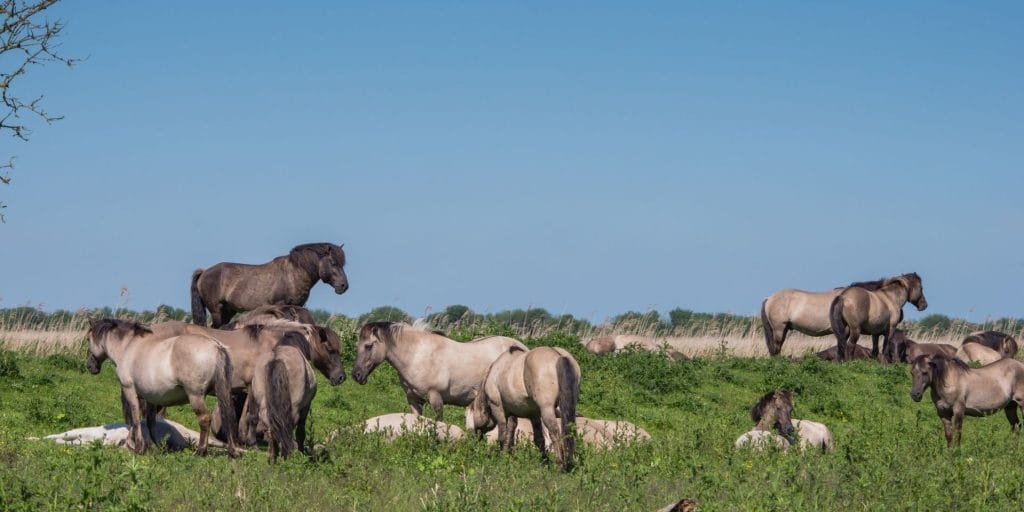
Existing families remain intact. Removals focus on individuals whose absence causes the least social disruption.
The principle is simple:
First observe. Then gather calmly. Then remove selectively.
Traps Are a Tool, Not a Solution
Traps are neither good nor bad. Their impact depends entirely on how they are used.
Without prior observation, traps become a random selection device.
With long-term monitoring, they become a precise management tool.
The difference is not the fence.
The difference is the planning.
A Biologically Informed Way Forward
Put together, this points to a different management framework:
Invest in long-term observation. Use fertility control as the primary tool to slow population growth. Support it with modern monitoring and AI-assisted identification. If removals are necessary, make them selective and socially informed.
Observe first. Capture second. Remove last.
None of this is radical.
None of it is theoretical.
Working examples already exist.
The question is not whether we can manage wild horses without long-term social damage.
The question is whether we are willing to prioritize it.
Understanding wild horse society requires patience, observation, and respect for long-term dynamics. And those same qualities are what shape a different kind of relationship with our own horses. And if you’d like to start exploring that, my new series ‘Beyond Behavior’ is a great first step. Six videos, two guides, one meditation – $7.
Or, if you’re ready to dive even deeper, explore the Being Herd Library and Program.
I can’t wait to see you there!
Recent Comments